

A local SEO landing page is a highly specific page on your website built to rank for geo-targeted searches—think ‘plumber in Brooklyn’ or ‘best coffee near me’. It’s not your homepage. Instead, it’s laser-focused on converting visitors from one particular area into actual customers by giving them exactly what they’re looking for, right where they are.
Why Your Homepage Just Won't Cut It for Local Search
One of the biggest mistakes I see businesses make is relying on their homepage to attract local customers. It seems logical, but it's an expensive misstep. Your homepage is your company's digital front door; it has to welcome everyone. That broad, one-size-fits-all message gets completely lost on a user with an urgent, local problem.
Think about it. Someone searching for "emergency roof repair in Denver" doesn't care about your national mission statement. They need to know, instantly, that you serve their neighborhood and can fix their leak—fast. This is where a dedicated local landing page shines. It cuts through the noise and acts as a direct funnel, meeting that searcher with the precise information they need, at the exact moment they need it.
To really win in local search, you have to move beyond a generic homepage. The key is creating effective local SEO landing pages designed to speak directly to specific cities, neighborhoods, and services.
This diagram shows that simple, powerful journey from a local Google search right to your door.
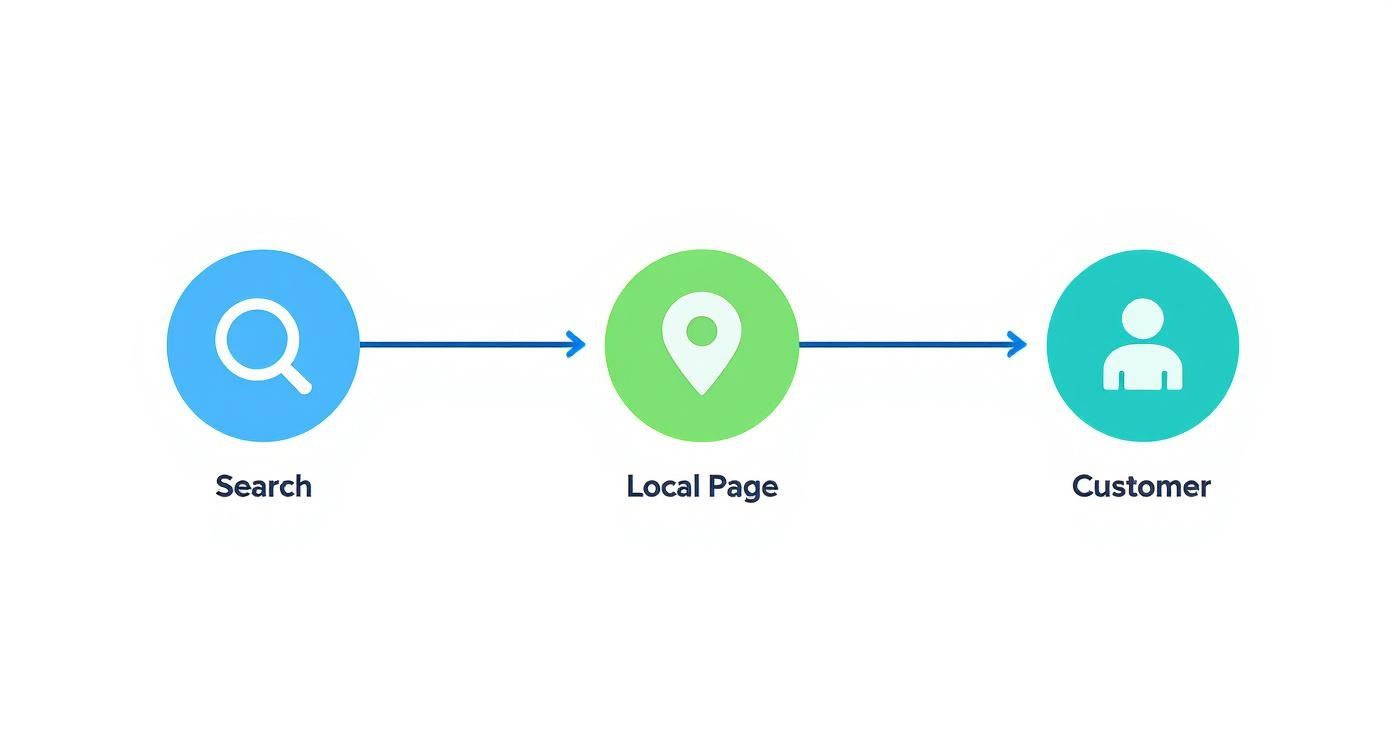
As you can see, the local page intercepts the user, giving them a targeted experience that makes it easy for them to become a customer.
Tapping Into Powerful Local Intent
The data on this is overwhelming. Local search isn't just a trend; it's how people find businesses now. A staggering 46% of all Google searches have local intent.
These aren't just window shoppers, either. These are high-intent searches that lead to a purchase 80% of the time, making local search one of the most profitable channels out there. When you consider there are over 1.5 billion 'near me' searches every single month, ignoring this audience is like leaving cash on the table.
A dedicated page lets you tailor every single element—your keywords, your content, customer testimonials, and contact info—to one location. This focus sends incredibly strong relevance signals to Google, which is exactly what you want.
Your homepage is like a giant billboard on the interstate—it gets a lot of eyeballs but speaks to no one in particular. A local landing page is the friendly sign in a neighborhood shop window. It speaks directly to the community it serves, building instant trust and connection.
Local Landing Page vs Standard Landing Page
At a glance, it might be tough to see the difference between a standard landing page and one built for local SEO. But their goals and structure are fundamentally different. This table breaks down the key distinctions.
This targeted approach makes all the difference. When a local searcher lands on your page, they immediately feel seen and understood, giving them the confidence that you’re the right choice for them right in their own backyard.
Writing On-Page Content That Actually Connects with Locals
This is where the rubber meets the road. Your on-page content is the heart and soul of your local landing page. It's your direct line to both Google and your ideal customer, proving you’re not just in their town, but you’re part of it. Forget generic service descriptions; we're creating something that resonates on a neighborhood level.
It all starts with getting inside the head of a local searcher. Broad terms like "plumber" are a waste of time—the competition is just too fierce. The real magic happens with long-tail, geo-specific keywords that scream intent.
Think about it. A search for "emergency plumber in Brooklyn" is a world away from a general search for "plumber." That person has a problem, they have it now, and they've told you exactly where they are. Your job is to be the answer they find.

Finding Your Hyper-Local Keywords
To dig up these gems, you need to go beyond the standard keyword tools. They’re a fine starting point, but the best insights come from thinking about how real people talk about where they live.
- Drill Down to Neighborhoods: Don't just target the city. Go for specific areas like "Williamsburg coffee shop" or "roofing contractor in The Heights."
- Embrace "Near Me": You won't literally stuff "near me" into your text, but you'll structure the page to implicitly answer that query by being unapologetically local.
- Talk Like a Local: Mentioning well-known landmarks or using regional slang shows you're not an outsider. A Dallas-based business, for instance, might talk about serving customers "north of the Trinity River."
Once you’ve got a solid list of primary and secondary keywords, it's time to weave them into the fabric of your landing page.
Where to Place Your Keywords for Maximum Impact
This isn't about keyword stuffing; it's about strategic placement. The goal is to make it crystal clear to search engines what your page is about and where you operate, all while sounding perfectly natural to a human reader.
Focus on these key spots:
- Example:
Expert Roof Repair in Denver, CO | Apex Roofing
- Example:
Need fast roof repair in Denver? Apex Roofing offers free inspections and emergency services for hail damage. Call our local team today!
- Example:
Your Trusted Partner for Roof Repair in Denver
Pro Tip: Write for your customer, not the algorithm. A genuinely helpful page that naturally includes local terms will always beat a page that’s awkwardly crammed with keywords. Google is more than smart enough to understand context.
Going Beyond Keywords: Create Genuinely Local Content
Here’s what separates the top-ranking pages from the rest of the pack. To truly establish your local authority, you have to create content that simply couldn't exist for any other location. You need to prove you belong.
This is all about demonstrating your deep connection to the community, which builds immense trust with users and sends powerful relevance signals to Google.
Here are a few ideas to get you started:
- Showcase Local Work: Feature a case study or before-and-after photos from a job you did in a well-known neighborhood. "See how we transformed this home in Wash Park."
- Feature Local Voices: Reviews from customers in the city you're targeting are pure gold. A quote from "Jane D. from Cherry Creek" carries so much more weight than a generic testimonial.
- Highlight Community Involvement: Do you sponsor the local little league team? Do you volunteer at a neighborhood food drive? Mention it! It shows you’re invested in the community's well-being.
- Reference Local Mainstays: Weave in references to local geography or well-known events. A moving company could say, "We know how to navigate the tight streets of Capitol Hill, even during the People's Fair."
This level of detail makes your business feel like a neighborhood fixture, not just some faceless corporation. You’re no longer just an ad; you’re a valuable local resource. And that’s exactly what both your customers and the search engines are looking for.
Building Trust and Authority with Local Signals
Great on-page copy is the foundation, but to really dominate local search, your landing page needs to become a true, undeniable part of the community it serves. This means sending strong, consistent signals to Google that prove you belong there. It’s not just what you say on your page; it's how that information gets confirmed all over the web.
This whole validation process hinges on the cornerstone of local SEO: NAP consistency. NAP stands for Name, Address, and Phone Number, and getting it right is the single most important trust signal you can send. This data needs to be an exact match everywhere it shows up online.
Think of it this way: if a friend gave you three slightly different addresses for a party, you'd get confused and lose confidence. Google feels the same way. Any inconsistency plants a seed of doubt, and that doubt can really hurt your rankings.
Your Google Business Profile Is Command Central
Your Google Business Profile (GBP) is the central hub for all your local information. It's the data source for the coveted Map Pack and what most searchers will see first. The details on your local landing page have to match your GBP listing perfectly.
- Business Name: Is it "Smith Plumbing LLC" or just "Smith Plumbing"? Decide on one and stick with it everywhere.
- Address: Don't write "St." on your page but spell out "Street" on your GBP. Every single character matters.
- Phone Number: Always use the same local phone number. Stay away from call tracking numbers on your core profiles, as they can create confusing discrepancies for search engines.
A fully optimized GBP is way more than a simple data entry task; it's a massive driver of traffic and new business. In fact, companies with complete Google Business Profiles are 70% more likely to attract location visits. On top of that, complete listings can get up to seven times more clicks than incomplete ones. This makes GBP optimization an absolute must-do.
Speaking Google's Language with Local Business Schema
To make sure Google understands your NAP data with zero confusion, you need to speak its language. That’s where Local Business schema markup comes in. Schema is a bit of code (structured data) that you add to your page’s HTML to explicitly tell search engines what each piece of information is.
It's like putting clear labels on your content. Instead of Google just seeing a string of numbers, you're telling it, "Hey, this is our phone number." It removes all the guesswork and solidifies your authority in that specific location.
Getting this done is easier than you might think. You can use a free tool like Google's Structured Data Markup Helper to generate the code for you. Here’s a quick JSON-LD example for a fictional local roofer:
{"@context": "https://schema.org","@type": "RoofingContractor","name": "Denver Peak Roofing","image": "https://www.denverpeakroofing.com/logo.jpg","@id": "","url": "https://www.denverpeakroofing.com/denver-co","telephone": "303-555-0101","address": {"@type": "PostalAddress","streetAddress": "123 Main St","addressLocality": "Denver","addressRegion": "CO","postalCode": "80202","addressCountry": "US"},"geo": {"@type": "GeoCoordinates","latitude": 39.739235,"longitude": -104.990250},"openingHoursSpecification": {"@type": "OpeningHoursSpecification","dayOfWeek": ["Monday","Tuesday","Wednesday","Thursday","Friday"],"opens": "08:00","closes": "17:00"}}This little snippet clearly defines the business's name, address, phone, and hours, leaving nothing up to interpretation.

Reinforcing Credibility with Maps and Reviews
Beyond the code, visual and social signals on your landing page are huge for building trust with both people and search engines.
Embedding a Google Map right on your page is a simple but surprisingly effective move. It gives users a visual confirmation of your location and one-click access to directions. That interaction is a positive signal Google pays attention to, proving your page is a genuinely helpful local resource.
Just as important is showcasing your local customer reviews. Testimonials from people in the actual city or neighborhood you're targeting are incredibly persuasive. A review from "Sarah K. in Five Points, Denver" has a layer of authentic, local credibility that a generic one just can't match.
By pulling in your latest Google reviews directly onto your landing page, you create a dynamic stream of fresh, relevant, local content. This not only builds social proof for visitors but also gives Google a reason to crawl your page more frequently.
Finally, remember your landing page doesn't exist in a bubble. Use it as the main website link in your GBP listing and across all your local directory citations (like Yelp, Angi, etc.). This creates a powerful, interconnected web of local authority. Every consistent citation is like a vote of confidence, funneling trust and ranking power right back to your dedicated local SEO landing page.
All these pieces work together to build a compelling case that your business is the best choice for local customers. Answering common questions on your page is another fantastic way to build that trust, and you can learn more about this in our guide to creating a great FAQ section for your website.
Designing Your Page for Local Conversions
Getting a potential customer to your local landing page is a huge win, but it’s only half the battle. Now, you have to convince them to do something—call you, drive to your store, or request a quote. This is where Conversion Rate Optimization (CRO) comes in, but for a local audience, the rules are a bit different. You aren't just selling a product; you're selling convenience, proximity, and trust within the community.
Every single element on your page needs to work together to create a frictionless path from visitor to lead. This means crafting calls-to-action (CTAs) that speak directly to a local user's immediate needs and designing an experience that respects their time—especially since most of them will be on their phone.
This image nails the vibe of a local business—it's inviting, personal, and feels like part of the neighborhood. Your landing page design should give people that same feeling.
Crafting Compelling Local Calls to Action
A generic "Contact Us" or "Learn More" button just won't cut it for a high-intent local searcher. They need a clear, direct next step that solves their problem right now. Your CTAs have to be specific, action-oriented, and feel like they were written just for them.
Instead of vague prompts, try these location-focused alternatives:
- "Get a Free Quote in Denver"
- "Schedule Your Brooklyn Roof Inspection"
- "Call Our Dallas Team Now"
These CTAs instantly confirm that you serve their area and tell them exactly what will happen when they click. The impact is huge. While the average landing page converts at around 6.6%, personalized CTAs can convert 42% more visitors than generic ones. Better yet, businesses with 10-15 dedicated landing pages see a 55% increase in leads. It’s solid proof that a tailored approach works.
If you want to go even deeper, you can learn more about how to improve website conversion rates in our detailed guide.
Prioritizing a Mobile-First Design
Let’s face it, the vast majority of local searches happen on smartphones. Someone's in their car looking for the nearest coffee shop or on their couch searching for an emergency plumber. This mobile-first reality has to be the foundation of your page design.
If your page is slow or difficult to use on a phone, you've already lost. Local searchers are impatient; they need answers immediately, and a clunky mobile experience is the fastest way to send them straight to a competitor.
This means your page must be fully responsive, with big, easy-to-tap buttons and simple, scannable text. And most importantly, it has to load fast.
Making Page Speed a Top Priority
Page speed isn't just some technical SEO checkbox; it's a core part of CRO. For local users on the go, often relying on cellular data, a slow-loading page is a dealbreaker. The data doesn't lie: pages that load in 2.4 seconds convert almost twice as well as slower ones.
You can use a free tool like Google's PageSpeed Insights to see how your page stacks up and get clear recommendations on what to fix. A high score, particularly for mobile, is a strong sign that you're giving users a smooth experience that encourages them to convert.
A Checklist of Must-Have Conversion Elements
To create a seamless experience that guides users toward taking action, make sure your local SEO landing page includes these essential CRO elements. They work by removing friction and building the confidence a user needs before they're willing to reach out.
Frictionless Contact Options:
- Click-to-Call Buttons: Your phone number absolutely must be a tappable link. This is non-negotiable for mobile users who want to connect with a single tap.
- Simple Contact Forms: Keep forms short and sweet. Only ask for what you truly need: name, phone/email, and a brief message. A long, complicated form is a notorious conversion killer.
Trust-Building Information:
- Clear Operating Hours: Put your hours somewhere prominent. Nothing is more frustrating for a local customer than not knowing if you're open.
- Visible Address and Map: An embedded Google Map not only helps with SEO but also visually confirms your location, making it dead simple for customers to get directions.
- Trust Badges and Certifications: Show off any local awards, BBB ratings, or industry certifications to establish credibility in seconds.
By combining hyper-local CTAs with a fast, mobile-friendly design and these user-focused elements, your landing page transforms from a simple online brochure into a powerful conversion machine. You're not just ranking for local terms; you're turning that valuable traffic into real business.
How to Measure Your Local Landing Page Success
Getting your local landing page live is a huge step, but the real work starts now. How do you know if it's actually working? To see the real impact of your efforts and prove its value, you need to be tracking the right data.
This isn't about just glancing at your overall website traffic. It's about connecting specific, local actions—like phone calls or direction requests—directly back to this page. A well-built local page is designed to make the phone ring or get people to your door. With the right tracking in place, you move from hoping it's working to knowing exactly how it's contributing to your bottom line.

The Key Performance Indicators That Matter
When it comes to data, your two best friends will be Google Analytics 4 (GA4) and Google Search Console. Each tool gives you a different piece of the puzzle. Search Console tells you how people find your page, and GA4 shows you what they do once they get there.
Focus your attention on these critical metrics:
- Local Organic Traffic (GA4): Don't just look at total traffic. In GA4, create a specific segment that isolates visitors landing only on your local landing page's URL. This shows you exactly how many people are finding this page through organic search.
- Keyword Rankings (Search Console): Keep a close eye on your page's average position for your core local keywords. I'm talking about "near me" searches and city-specific terms like ‘plumber in Brooklyn’. Seeing these rankings climb is a direct sign your SEO is paying off.
- Impressions & Clicks (Search Console): This one's simple. How many times does your page show up in local search results (impressions), and how many people actually click on it? If you have tons of impressions but very few clicks, your title tag or meta description probably isn't compelling enough.
- Conversion Rate (GA4): This is the money metric. You need to set up event tracking for the actions that matter most, like clicks on your phone number, form completions, or taps on the "Get Directions" button. Your conversion rate is simply the percentage of visitors who take one of these valuable actions.
While local signals are a huge part of the equation, don't forget the fundamentals of good design and user experience. It's always a good idea to read up on how to optimize landing pages for better conversions to make sure your page is truly set up for success.
Setting Up a Repeatable Maintenance Workflow
Here’s a secret from the trenches: a successful local landing page is never "finished." It needs ongoing care to stay effective. A simple, repeatable workflow is your best defense against performance decay.
I always tell my clients to think of their local landing page like a physical storefront. You wouldn't just build it and walk away, right? You'd keep the windows clean, update the displays, and make sure the 'Open' sign is always lit. Regular maintenance keeps it inviting for both customers and search engines.
This proactive mindset helps you protect your hard-earned rankings and ensures the page continues to be a powerful asset. The data you're tracking will feed directly into this process, creating a virtuous cycle of constant improvement. For a deeper dive, you can learn more about how to boost your organic search visibility in our comprehensive guide.
Your Monthly Maintenance Checklist
Just set aside a little time each month to run through this checklist. This discipline will help you spot problems early and jump on new opportunities before the competition does.
- Review Performance Data: Pop into GA4 and Search Console. How are your key metrics looking? Are rankings holding steady? Is traffic trending up? Are you still getting conversions?
- Hunt for New Local Reviews: Fresh, positive reviews on your Google Business Profile are pure gold for local SEO. Make it a habit to ask recent, happy customers in your target city for feedback.
- Update On-Page Content: Keep things fresh. Add a new testimonial from a local customer or drop in a photo from a recent job you completed in the area. These small tweaks signal to Google that your page is active and relevant.
- Check for Technical Glitches: Run a quick mobile-friendliness test and check your page speed. Click every link, button, and form to make sure everything still works perfectly.
By consistently measuring and maintaining your local landing page, you turn it from a one-and-done project into a reliable engine for local growth.
Common Questions About Local SEO Landing Pages
https://www.youtube.com/embed/poCZXyJ_-co
Even with the best strategy laid out, you're bound to run into a few specific questions when you get down to the nitty-gritty of building a local SEO landing page. Let's clear up some of the most common ones we hear from marketing leaders and SEO consultants.
Getting these details right is what separates a page that just exists from a page that actually gets results.
How Many Local Landing Pages Do I Really Need?
The golden rule here is pretty simple: one unique landing page for each physical business location. This allows you to create a page that's laser-focused on its specific community, complete with the right address, phone number, and local testimonials that resonate with people in that area.
But what about service-area businesses without a public storefront? The approach is similar. You'll want to create a dedicated page for each major city or distinct, populated neighborhood you serve. The key is to resist the urge to create dozens of thin, nearly identical pages for every tiny suburb. Instead, concentrate your efforts on the areas where you have a real customer base and can create genuinely valuable content that shows you belong there.
Don't fall into the trap of quantity over quality. A handful of well-crafted, genuinely local pages will always outperform a hundred generic, cookie-cutter ones. Google rewards value, not volume.
Google Business Profile vs. a Local Landing Page: What’s the Difference?
This one trips a lot of people up, but it’s best to think of them as a team. Your Google Business Profile (GBP) is essentially your business's listing in Google's directory. It's that quick snapshot people see in the Map Pack or local search results, and its job is to grab their initial attention.
Your local landing page, on the other hand, is the destination. It's a page on your own website where you send all that valuable traffic you get from your GBP. The GBP makes the introduction, but your landing page is where you close the deal by providing the depth—detailed service descriptions, case studies, team bios—that convinces a visitor to become a customer.
A strong GBP sends you traffic; a strong landing page turns that traffic into revenue.
Can I Just Reuse Content and Swap Out the City Name?
I get it, this is a tempting shortcut. But it's also one of the biggest mistakes you can make. Simply finding and replacing a city name across identical pages is a fast track to creating what Google calls "doorway pages." These are seen as low-quality content that can tank your rankings.
Besides, users can spot generic, boilerplate content from a mile away. It just doesn't build trust. While your core service descriptions might be similar, each local SEO landing page needs its own unique flavor to be effective.
Here’s how to do it right:
- Local Testimonials: Pull reviews from customers in that specific city.
- Location-Specific Photos: Show your team working on real jobs in the area.
- Community Mentions: Talk about your sponsorship of a local sports team or involvement in a neighborhood event.
- Neighborhood Case Studies: Detail a project you completed for a well-known local business or in a recognizable part of town.
This level of customization proves to both people and search engines that you’re a real, active part of that community. That's how you build the trust and relevance needed to rank.
Ready to answer your customers' real questions automatically? Faqir is an AI assistant that finds what your customers are asking in calls and emails and turns those questions into a powerful, SEO-friendly FAQ section on your website. Help buyers make decisions faster and reduce your support tickets. Explore Faqir today!